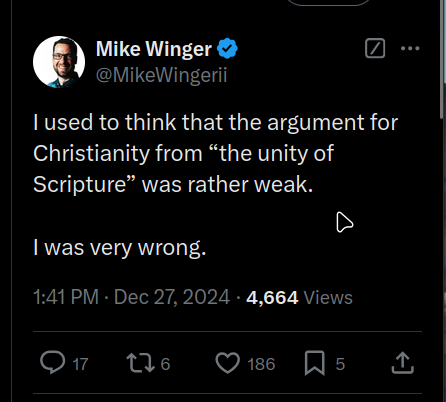
Fascinating topic:
x.com/MikeWingerii/stat…

The “unity of scripture” refers to its internal consistency:

1. It is internally consistent in terms of its meaning, so long as you interpret it according to the principle of *analogia scripturae*, which means literally “analogy of scripture” but which refers to the principle that Scripture should be used to interpret Scripture. The point is that you *can* interpret Scripture in this way.

2. It is doctrinally consistent, meaning that different parts do not express inconsistent doctrines. Again, this also depends on *analogia scripturae*.

3. It is metaphorically consistent; the principle here is intertextuality. Symbols bear the same meaning across many centuries of writing.

4. It bears up under close scrutiny. It invites questioning (assuming the one is up to the task of discerning answers!).

This is an essential part of an Argument from Revelation.
My book in progress develops an Argument from Revelation over six chapters (and counting…ugh). A couple chapters establish that the Bible describes God in a way that precisely fits claims made about God in natural theology—not just the conclusions, but the premises, at a fine-grained level of detail.

A second section essentially exhibits the plausibility of the Bible, essentially retelling the story and showing that it constitutes an expression of the words and actions of God that we might antecedently expect, not just because they fit the presuppositions of natural theology, but because they make a consistent, coherent, and rational system. Good students of the Bible understand how the Bible *really does sound* like it was written by God.

You are not currently signed in. Please sign in or use the link below (requires minifeed.org).
Like a post to share the love.
Log in Sign up
Reply to join the conversation.
Log in Sign up